Wind power is an essential renewable energy source and over the last few decades, wind turbines have become one of the most valuable methods of reducing coal gas emissions.
According to the Global Wind Energy Council’s (GWEC) Global Wind Report 2023 , 2022 was the third best year ever for new capacity, with 78 GW added globally, taking total global installed capacity to 906 GW – a year-on-year growth of 9%.
It’s forecast that 2023 will be the first year to exceed 100 GW of new capacity added globally, with the market set to achieve year-on-year growth of 15%.
There is strong growth in established European markets such as Germany, Spain, the UK, France, Italy and Turkey – driven by the energy system reform and replacing fossil fuels with renewables to achieve energy security in the aftermath of Russia’s invasion of Ukraine.
In order to keep up with such rapid growth, the sector is constantly innovating to ensure it operates at peak performance. In this blog, we explore some of the most exciting trends and technologies that are shaping the future of the industry.
Data and analytics
Like the majority of industries, data and the many ways it can be interpreted is having a major impact on driving more efficiency within the wind energy sector. The accelerated use of data and specialist software to plan, operate and maintain rapidly growing fleets of offshore wind turbines is empowering stakeholders.
Data plays a major role in planning wind energy projects, such as informing choice of location and the number and type of turbines required. However, it’s in the field of maintenance that data and analytics are really proving their worth.
It’s possible to gather real-time data from equipment and record over a billion events each day, ensuring that turbines are running safely and at the lowest possible cost. What’s more, autonomous drone inspections and turbine inspection data have become more robust than ever, allowing for predictive maintenance to be carried out – by robots in some cases.
Companies are able to identify trends they can draw conclusions from — what happened to cause damages and why? What will likely happen in the future, and what can they do next to prevent or prepare for future issues? With such powerful insights available, it’s unsurprising that an increased number of operators are considering self-operation and there’s a growing desire to use data to make more efficient and effective decisions and increase profits.
Turbine design
The size of a wind turbine and the length of its blades determines how efficiently it runs, so research into new technologies often focuses on those two areas. As a result, blades are now longer, lighter and having increased durability thanks to major advancements in manufacturing and materials, such as 3D printing.
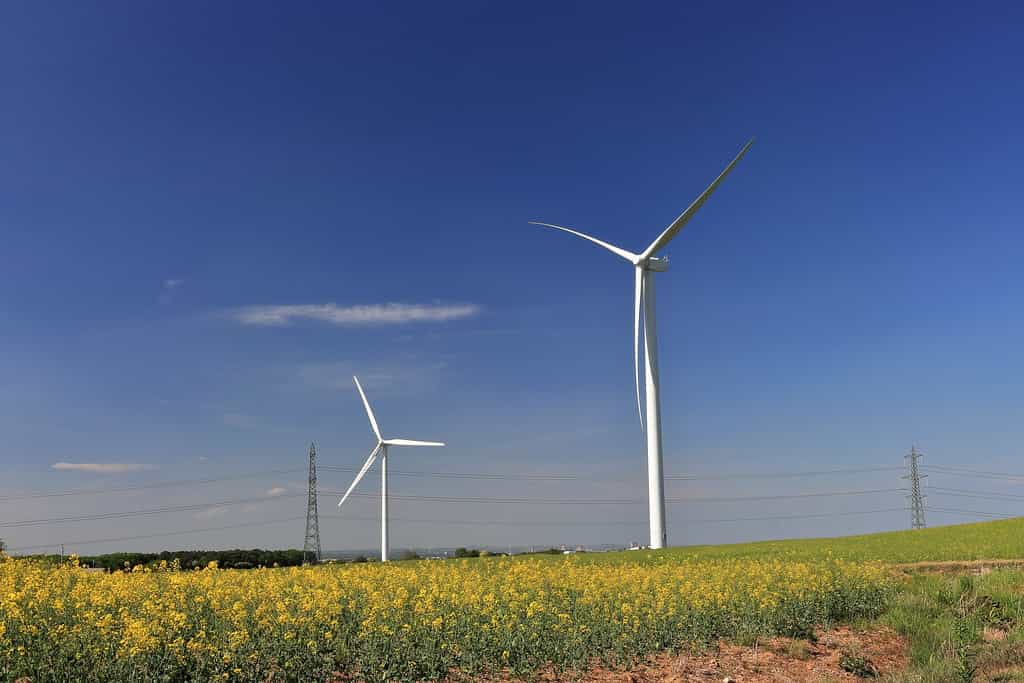
Different blade designs have also come to market over recent years, including those with curved tips that catch the wind more efficiently and wind deflecting turbines that divert wind that hits the tower to the blades, harnessing energy that would otherwise have been lost.
Further advancements include digital twin modelling systems that enable remote configuration of wind turbines and farms for peak performance, 3D modelling and simulation. This allows for assessment of new technologies and designs before testing them in the field and smart blades which adjust themselves to the wind flow to remain at peak performance and efficiency.
Airborne wind energy
Taking futuristic design to new heights and garnering much investor interest is something called Airborne Wind Energy (AWE). Imagine a wind turbine without the tower – AWE concepts float in the air like a kite while the wind turns the blades and generates electricity. Without the tower, manufacturing and installation costs are much cheaper and AWE has the potential to reach higher altitudes and take advantage of stronger winds, particularly offshore.
According to Airborne Wind Europe, AWE concepts are based on ‘flying blades or wings attached to the ground by a tether’. More research is needed, but it’s an emerging technology that will make wind energy more efficient in the future.
The uptake in wind energy has led to a wave of new wind power technologies. Advancements are not only driven by a desire for greater efficiency but an increase in demand, as global attitudes shift towards renewable sources to reduce reliance on fossil fuels and accelerate the journey to net zero.
For more information on how AIS Wind Energy is supporting the sector as it develops, contact us.