As of 2026, a significant proportion of Wind Turbines (WTs) are reaching 20–30 years of age. Issues around component degradation are now taking centre stage. As a result, ageing components, such as service lifts, require increased inspection, refurbishment and risk management.
Increased scrutiny on service lifts from the HSE
Incidents involving service lifts (such as this incident where a service technician suffered serious injuries when his hand became trapped in a service lift) has led to the HSE intensifying their focus on turbine safety systems.
A new standard, BS EN 81‑44:2024, was developed in response to a former absence of defined industry standards for the safe design of service lifts, which led to discrepancies in the application of required safeguards by designers and manufacturers. As this posed a potential risk to users, there is now heightened regulatory pressure to demonstrate adequate design, guarding, and safe positioning of controls for service lift systems.
The role of service lift inspections
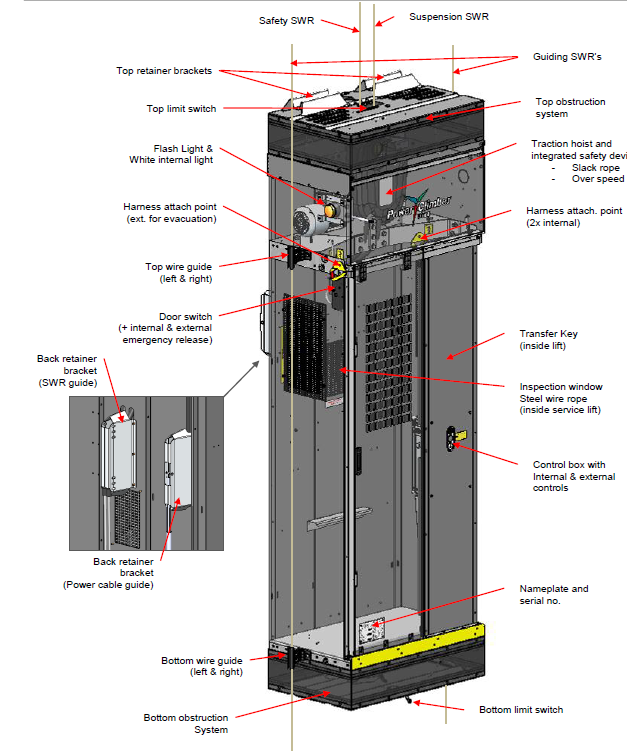
Service lift inspections play a vital role in protecting the technicians who rely on these systems every day, and their condition directly affects the safety of anyone working within the tower. Regular inspections provide the assurance that every component, from guarding systems to control interfaces, is functioning as intended, without hidden defects that could place users at risk.
Ability to identify hazards
Hazards that develop gradually through wear, environmental exposure, or repeated use can be identified during a service lift inspection. Issues such as deteriorating guarding, misaligned controls, or increased access to moving parts often emerge slowly and may go unnoticed during daily operation. Formal inspections ensure these risks are discovered before they compromise technician safety, reducing the likelihood of crushing, entrapment or accidental contact with hazardous mechanisms.
Demonstrates ongoing compliance
Inspections are also essential for demonstrating ongoing compliance with the evolving regulatory landscape. Standards such as PUWER, the Supply of Machinery Regulations, and BS EN 81‑44:2024 set clear expectations for how service lifts within turbines must be designed, maintained and operated. Routine inspections verify that lifts continue to meet these requirements over time, giving operators confidence that both legal duties and industry best practice are being upheld.
Consistent inspection routines contribute to overall operational reliability
When service lifts are functioning as designed, technicians can move efficiently and safely through the turbine, enabling maintenance to proceed without avoidable delays. Identifying faults early reduces the risk of sudden lift failures that could halt essential work or force technicians into less safe access methods. By supporting reliability, inspections play a direct role in maintaining turbine availability and reducing avoidable downtime, as well as costs associated with this.
The cost of failing a service lift inspection
Failure to pass a service lift safety inspection can lead to serious consequences:
- HSE enforcement actions including improvement notices requiring corrective action, and prohibition notices stopping the use of unsafe equipment until issues are fixed.
- Potential legal action if non‑compliance risks serious harm. The HSE explicitly instructs operators to withdraw lifts from use if guarding or control placement is unsafe.
- Costs associated with re-inspection fees, corrective repairs, and unplanned downtime due to operational disruption.
- If operators breach OEM agreements, O&M contracts, or certification requirements, this can negatively affect investor confidence and damage a WT operator’s reputation.
Don’t put off your service lift inspections
Service lift inspections should be done every six months and should not be put off. To book a service lift inspection with our specialist team, find out more here.