At AIS Wind Energy, we’ve been delivering wind turbine and wind farm decommissioning projects across Europe in Norway, Germany, Scandinavia, Finland and the UK for many years. Working with onshore wind farm operators of all sizes and ingraining ourselves in the renewable energy sector, we’ve learned the most commonly asked questions about onshore wind energy in the UK.
Here are the top five:
How long does it take to build an onshore wind farm?
Compared to their offshore counterparts, onshore wind farms are built quickly. A smaller onshore 10 megawatt farm can take 8-10 weeks, while a 50 megawatt farm can take up to six months. This is primarily because access is much easier with onshore compared to offshore projects. Even if some kind of road has to be made first, it’s still cheaper than the various boats and helicopters required for offshore projects.
However, the whole process, including securing land, planning permissions, and sourcing the turbines, can be much longer. Planning consent has been a subject of major governmental discussion in recent months, with plans to reduce the time it takes for consent for onshore wind farms and bring it more in line with other infrastructure projects. It can take years to obtain consent and get everything linked up to the grid, but with the government’s desire to increase wind energy output, this will likely be reduced.
What makes a good onshore wind farm location?
Onshore wind farms are generally best suited to areas with high wind speeds, such as open valleys, or at altitude. They are typically located in more rural areas where buildings don’t interrupt wind flow and noise pollution is less of a concern. Some of the UK’s most prominent onshore wind farms are in Wales, Scotland and Northern Ireland – areas that are also among the windiest.
Parts of England are well suited to onshore wind energy – especially in the north of England, East Anglia and Cornwall – but the frequency of national parks, nature reserves and other protected spaces makes planning more arduous and even unlikely.
How are onshore wind turbines installed?
Installing onshore wind turbines requires specialist support, expertise, resources, and equipment.
Wind turbines stand at heights of up to 150 metres and have a blade span of approximately 50m. The scale of turbines, combined with their location in typically hard-to-access areas, means wind farm operators need specialist support to ensure successful and safe installation, commissioning and operation.
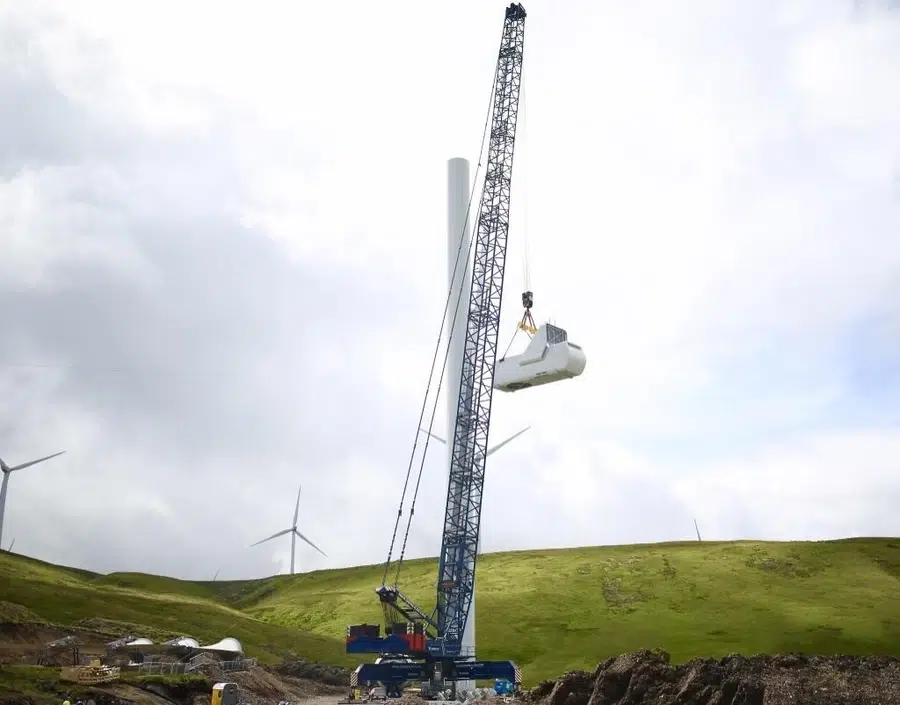
As wind turbine components are of considerable weight – for example, a wind turbine blade weighs circa 12 tonnes, and the nacelle, which contains the generator, can be close to 300 tonnes – a series of complex and very heavy lifts are required. Doing all of this in a safe, controlled manner can be immensely difficult, and it’s important not to overlook how dangerous cutting corners can be.
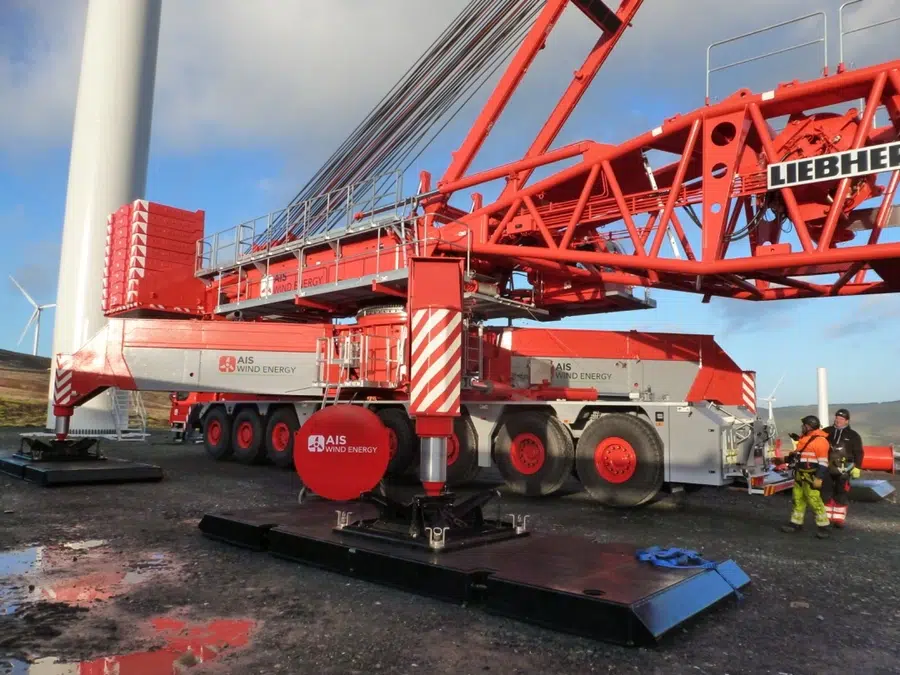
Each lift must be planned and orchestrated with precision and requires the right blend of experienced heavy lifters, technicians, and specialist heavy lifting equipment. Our recent investment in a Liebherr LG 1750 lattice boom mobile crane is integral to our work in the onshore wind sector as it can lift 400t at 20m radius and up to 105t at a 165m hook height and 34m radius on SX configuration.
The primary stages of onshore wind turbine installation are to survey the area and site access, prepare the ground and lay foundations, assemble the wind turbine components on site, lift them into place, connect them to the grid and carry out a series of connection and wind turbine commissioning tasks.
At AIS Wind Energy, we’ve installed and commissioned thousands of wind turbines across the UK and Europe. We understand the need for meticulous planning, careful execution and a thorough commitment to safety-first practices. All of our planning processes and operations are informed by the years of experience we have under our belt, allowing us to substantially increase both the safety and efficiency of every project that we participate in.
What maintenance do onshore wind turbines require?
Wind turbines operate in harsh environmental conditions and are subject to various operational strains. Damage can come from weather ingress, erosion, bird strikes, and the rigours of operation, so regular servicing and maintenance are vital. Without this servicing, it’s unlikely that the turbines will reach the end of their projected life spans, and operators stand to waste a lot of money.
Servicing helps to keep turbines working at optimal performance and ensures that potential causes of failure are spotted and addressed in advance. This helps to prevent the onerous financial losses of unplanned downtime, which cost the wind sector £1m per lost megawatt and operators more than £5,000 per day. It also ensures that warranties remain valid and that more significant tasks, such as component replacement or component retrofitting, can be planned with plenty of time.
Regular preventative wind turbine maintenance includes inspecting, lubricating, cleaning, testing and repairing tower sections, couplings, blades, gearbox, generator, blade bearings, main ring bearings and electrics. It may also be necessary to replace wind turbine component components as parts expire.
At AIS Wind Energy we help to design scheduled wind turbine maintenance programmes for onshore wind farm operators, as well as replace wind turbine components and deliver maintenance programmes to improve operational efficiency, address wear and tear and prolong the lifespan of assets. Regular servicing and maintenance is the key to giving onshore wind farm operators the longevity, security and reliability they need.
What happens when an onshore wind turbine reaches the end of its life?
The typical lifespan of a wind turbine is 25 years, assuming it has been well maintained during its operation. When a turbine is at the end of its life it is decommissioned and removed from the landscape. A full decommissioning project can take between six and 24 months to complete, subject to the number of turbines in question. and how easy (or difficult) the turbines are to access.
The process requires four main stages:
Stage 1
This involves comprehensive preparation and the creation of a decommissioning plan, a method statement to explain how the turbine will be removed as well as a thorough risk assessment. We operate within the Wind Turbine Safety Rules (WTSRs) and adopt a safe system of work (SSoW) for every project.
Stage 2
The wind turbine is isolated from the grid, before it’s fully disconnected with a mechanical and electrical de-install by certified electricians. This will also mean staying in communication with the energy grid, to ensure that everything is done to minimise any unexpected impacts that grid isolation could otherwise have.
Stage 3
The wind turbine’s five major components are removed – foundation, tower, rotor, hub, nacelle and generator – before moving on to more minor parts. They are all lowered to the ground in a series of lifts using our own fleet of lifting equipment and a team of heavy lifters and mechanical and electrical technicians.
Stage 4
The components are loaded onto transport before being taken off-site. Wind turbines are estimated to contain 8,000 parts, many of which can be recycled. Steel, iron, aluminium, copper, concrete and electronic parts, including wiring, are typically sent for recycling.
If a wind turbine is replaced with a completely new one, then this process is followed in reverse to install a new wind turbine. If the land is being returned to nature, further work is required to reinstate it to pre-project conditions by removing cables and foundations from the land, as well as replanting local vegetation, restoring ground drainage, and recreating public pathways and access.
What does the future of wind energy look like?
There is growing political support for onshore wind energy as an important way to support the UK’s net zero goals. The government has already ended the moratorium on new onshore wind projects, and it’s now expected that 30GW of new onshore wind capacity will be developed by 2030. As the impetus to reduce the country’s reliance on fossil fuels grows and advances in wind turbine technology continue – wind power, and onshore wind in particular, is set to become central to the UK’s energy strategy.
This shifting landscape can be difficult to keep up with, especially with ongoing government U-turns, but it’s imperative that wind farm operators take action to stay up to date.
For more information on how AIS Wind Energy supports the onshore wind sector with installation, commissioning, decommissioning, maintenance, component replacement and servicing, get in touch.